
The Political Dimension of Forest Fire-Related Health Issues

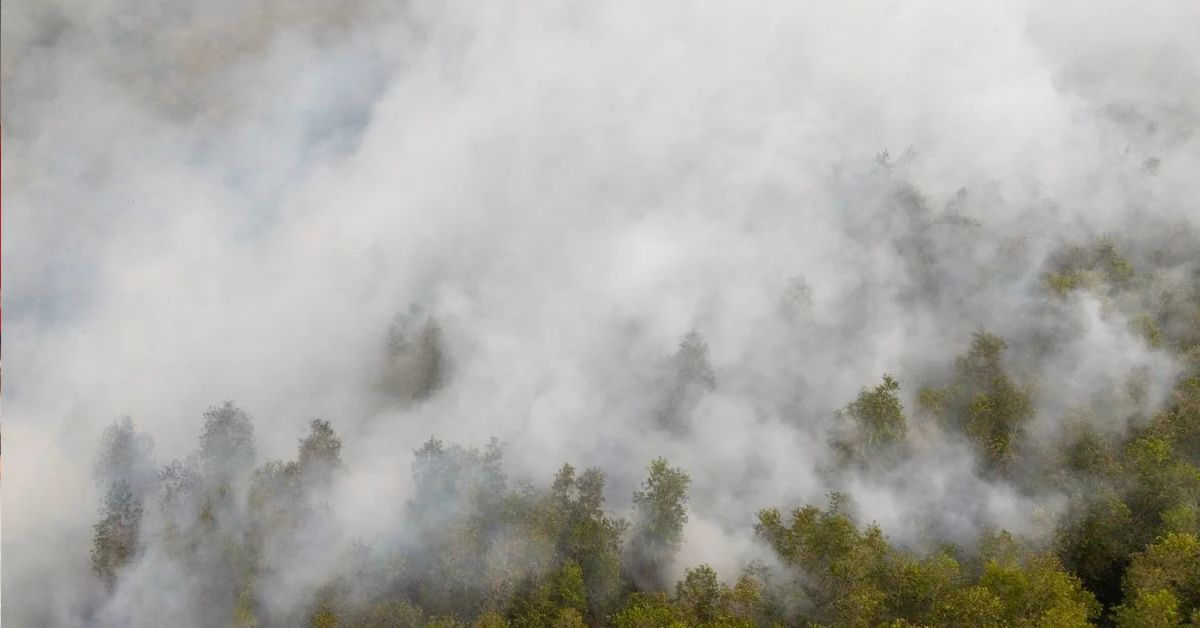
Forest and land fires in Sumatra and Kalimantan have not yet fully come to an end. In fact, this year’s fire season is being described as the worst in the last eleven years.
Smoke knows no administrative boundaries. It has blanketed various parts of Indonesia, drifted toward Malaysia and Singapore—even forcing the closure of schools in some Malaysian regions due to deteriorating air quality—and its impact on public health is already evident. Data from the Ministry of Health, as cited by Reuters, indicates that more than 12.5 million people across seven provinces in Sumatra and Kalimantan have been exposed to the haze.
The number of respiratory-related cases linked to the fires rose from 50,891 on September 1 to 113,336 by September 9. For the health sector, the appropriate response is relatively clear: the public must be informed about the risks of exposure, vulnerable groups must be protected, face masks should be provided, air quality must be monitored, and healthcare facilities must prepare for an increase in respiratory illnesses.
However, the capacity of the health sector has its limits. Doctors can treat shortness of breath; community health centers (puskesmas) can manage respiratory tract infections; hospitals can care for patients whose conditions have worsened; and healthcare workers can advise the public to reduce outdoor activities when air quality is poor. Yet, they cannot address the root cause—the forest fires themselves. Improving peatland management, controlling land clearing via fire, setting plantation policies, restoring ecosystems, and enforcing the law against those responsible for the fires all fall outside the scope of the health sector.
This is where forest fires remind us of a concept often overlooked in health discussions: health is not merely a biomedical issue.
It is also a social and political matter. When the root of an illness stems from social conditions—the World Health Organization (WHO) has long emphasized the importance of the "social determinants of health"—it becomes clear that the circumstances in which a person is born, grows, works, lives, and ages all play a role in shaping their health. However, there is a deeper layer: the political determinants of health. Ilona Kickbusch, an expert in health politics, explains that health is inherently political—partly because its distribution is unequal, many of its determinants depend on political action, and health is a matter of rights and citizenship.
The distribution of power, resources, interests, and government decisions ultimately shapes who remains healthy and who bears the risk of illness.
Forest fires serve as a stark example. PM2.5 particles from wildfire smoke can penetrate deep into the lungs and enter the bloodstream.
Such exposure is linked to an increased risk of respiratory and cardiovascular diseases, and it can exacerbate conditions in individuals with asthma, chronic lung disease, or heart disease. Children, the elderly, pregnant women, those with chronic illnesses, outdoor workers, and groups unable to effectively shield their homes from smoke face a significantly higher risk.
Yet, the level of PM2.5 in the air is not merely a natural occurrence. It is shaped by decisions regarding spatial planning, land-use permits, peatland protection, agricultural and plantation practices, law enforcement, ecosystem restoration, and government investment in fire prevention and response.
While extreme weather and phenomena like El Niño certainly amplify the risk, a region’s vulnerability to fires is also fundamentally influenced by the state of its ecosystem.
Therefore, when millions of people breathe polluted air, the issue extends well beyond whether healthcare facilities have an adequate supply of masks or medication. We must ask a more profound question: what policies allow these risks to persist and recur?
Politics Shapes Health
There are at least three ways to understand how politics can influence public health.
First, through public policies outside the health sector.
Policies concerning forestry, energy, transportation, industry, plantations, housing, and the environment can have a health impact that is just as significant—if not greater—than policies explicitly labeled as health programs.
Forest fires clearly illustrate this connection.
Decisions regarding the protection of peatlands and the enforcement of laws against land clearing by fire directly influence how many people will suffer from respiratory distress. In other words, environmental policy is, in effect, also health policy.
Second, politics determines the capacity of the health system to respond to such impacts.
When fires occur, there is a need for surveillance systems, healthcare personnel, medicines, oxygen, masks, emergency services, and the ability of healthcare facilities to handle a surge in patients.
In this context, a government’s decision to prioritize populist projects over addressing forest fires can have a critical impact on the institutional capacity to manage environmental and health issues—which, in turn, affects public health.
Such capacity is the result of political decisions made long before a disaster strikes—decisions regarding budget priorities, the distribution of healthcare workers, and investments in public services.
Third is the issue of health equity.
While smoke may blanket an entire city, the ability of individuals to protect themselves varies.
Some families can run air purifiers all day and work from home. Others—such as drivers, construction workers, farmers, street vendors, and those in the informal sector—must remain outdoors because their livelihoods depend on their daily earnings. The risk is present in the air for everyone, but the ability to avoid it is not distributed equally.
This is where forest fires become not just an environmental or health issue, but a matter of social justice.
Health can also influence politics.
The relationship between health and politics is not one-way. Politics shapes health, but people’s experiences with health and public services can, in turn, shape their relationship with political institutions.
Research by the European Observatory on Health Systems and Policies suggests that negative experiences regarding health and public services can be linked to low levels of trust in government institutions and democracy.
Health conditions can also affect an individual’s ability to participate in political life, whether due to mobility, economic, or social barriers. These findings do not necessarily mean that every health crisis automatically dictates the political choices of the Indonesian public. However, there is an important lesson: a government’s ability to protect public health serves as one of the most tangible manifestations of the state’s presence.
For this reason, the effectiveness of fire management can directly influence public trust.
In October 2026, community groups and Indigenous peoples in West Kalimantan took the issue of fires and haze to court by filing a lawsuit against several government institutions.
This legal action demonstrates how environmental and health concerns can evolve into demands for political and legal accountability.
Haze is also a geopolitical issue. There is another political dimension that is equally significant: smoke does not stop at border crossings.
In August 2026, the ASEAN Specialised Meteorological Centre raised the alert level for the southern ASEAN region after detecting moderate to dense haze originating from Kalimantan and spreading across national borders.
Malaysia, Singapore, and Indonesia have also engaged in coordination efforts regarding haze mitigation.
Since 2002, ASEAN has had the "ASEAN Agreement on Transboundary Haze Pollution," designed to prevent, monitor, and address forest fires and transboundary haze pollution through national and regional cooperation. Indonesia ratified this agreement in 2014.
Consequently, the success of fire management is not merely a domestic matter. When smoke from one country causes schools in another to close, leads to a deterioration in air quality, and disrupts public life, a health issue effectively transforms into a matter of international relations.
Ultimately, the capacity to prevent and manage fires becomes a component of Indonesia’s credibility in environmental governance within the ASEAN region. The greatest lesson may, in fact, be a simple one. We cannot place the entire responsibility for safeguarding public health solely on the Ministry of Health, healthcare workers, community health centers, and hospitals. Some of the root causes of health issues lie outside the health sector.
The WHO has long advocated for a "Health in All Policies" approach—integrating health considerations into decision-making processes across all sectors.
Forest fires illustrate why this approach is vital.
Ministries responsible for forestry are making decisions that affect health. Local governments, which oversee land-use permits and spatial planning, are making decisions that affect health. Institutions that enforce environmental laws are also making decisions that affect health.
The same applies to businesses that determine how land is managed. While these entities may not have the word "health" in their names, their decisions can ultimately dictate how many people end up requiring medical care.
Therefore, a long-term response to forest fires cannot simply consist of distributing face masks once the sky is already thick with smoke.
Governments must strengthen fire prevention, peatland restoration, the oversight of land concessions, law enforcement, early warning systems, healthcare preparedness, and the protection of groups most vulnerable to exposure.
Don’t Say Politics Doesn’t Affect Health
For the public, forest fires offer a lesson on the connection between daily life and politics.
There is a compelling observation attributed to the philosopher Pericles: “Just because you do not take an interest in politics doesn't mean politics won't take an interest in you.” In Indonesia, a common sentiment—often circulated online—is that it makes little difference to one’s personal life who becomes president, governor, or a local leader.
From a public health perspective, this assumption is worth questioning. Political decisions can determine the quality of the air we breathe, the water we drink, the safety of the food we consume, the availability of parks for physical activity, the condition of the roads we use, and even the capacity of community health centers and hospitals to provide care when we fall ill.
This means that citizens’ interest in politics should not be limited to a candidate’s personality, symbols, or communication style.
The public can look deeper: what policies are being proposed, what is the track record of their implementation, how strong is the commitment to the environment and public health, and are there accountability mechanisms in place for when policies fail to protect the public?
While political choice remains the absolute right of every citizen, understanding the health consequences of a policy makes political participation far more substantive.
Ultimately, forest fires reveal the limitations of an approach that confines health issues solely to the hospital setting. When a child suffers from respiratory distress due to haze, medical and health professionals can certainly provide treatment.
But to ensure that the same child does not end up breathing in smoke again next year, the solution no longer lies in the hands of a doctor.
The solution lies in public policy, environmental governance, law enforcement, and the political decisions that dictate how our forests and lands are managed.