
UIN Jakarta Pharmacy Hosts "International Health Sciences Insight Series 1" to Discuss Research Skills and Preparation for Pharmacy Students
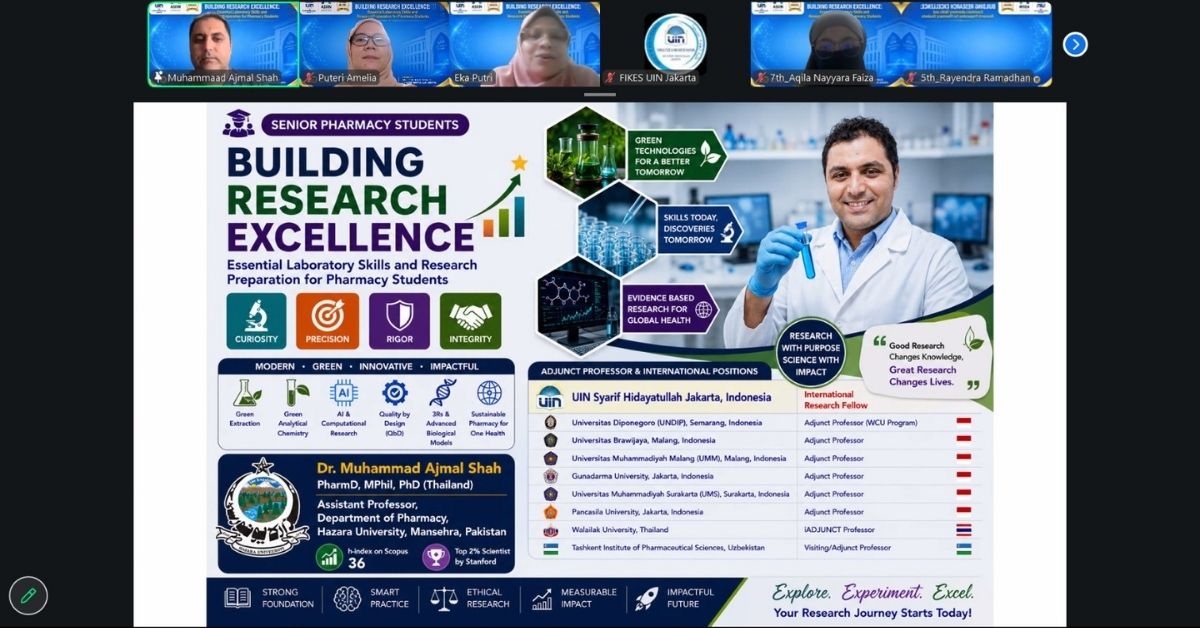
Jakarta, FIKES Online News — The Pharmacy Study Program at UIN Syarif Hidayatullah Jakarta hosted the "International Health Sciences Insight Series 1," themed "Building Research Excellence: Essential Laboratory Skills and Research Preparation for Pharmacy Students," on Friday, August 14, 2026, via Zoom. The event, held from 09:00 to 11:30 WIB (Western Indonesian Time), featured Dr. Muhammad Ajmal Shah, Ph.D., an Assistant Professor in the Department of Pharmacy at Hazara University, Pakistan.
The event began at 09:00 WIB, hosted by moderator Rosyifa Sayyida. The agenda included a Quran recitation by M. Anang Anggi Dwi Putra, the singing of the Indonesian and Pakistani national anthems, and opening remarks by the Head of the Pharmacist Professional Education Study Program, apt. Puteri Amelia, Ph.D.
The session proceeded with an introduction by the moderator, Dr. apt. Eka Putri, M.Si. She introduced Dr. Shah as an Assistant Professor in the Department of Pharmacy at Hazara University, Pakistan, noting his status as a researcher with a Scopus H-index of 36 and his inclusion in the list of the "World's Top 2% Scientists."
In his presentation, Dr. Shah explained that research is a repetitive and systematic process of inquiry aimed at finding solutions to problems. He emphasized that a researcher must first understand the problem before determining the appropriate solution. Research outcomes can take the form of new technologies, designs, information, or products, whereas innovation involves developing a discovery to make it more economical, practical, and aligned with current needs.
Dr. Shah also highlighted the importance of research in the field of pharmacy. Pharmaceutical research bridges pharmaceutical science and healthcare services through the study of diseases and medications, as well as the development of improved solutions. For pharmacists, research skills are crucial because various medication-related issues—such as availability, efficacy, and side effects—require solutions grounded in scientific evidence. Pharmacists are also expected to possess research skills to evaluate drug interactions, identify adverse effects, and support more personalized and effective therapies.
Furthermore, Dr. Shah outlined four key reasons why research skills are vital in pharmacy: evidence, discovery, development, and practice. Through *evidence*, pharmacists can evaluate scientific information based on empirical data. *Discovery* supports the identification of new molecules, targets, mechanisms, and compounds. *Development* plays a role in optimizing formulations or designs into superior products, while *practice* ensures that research findings are applied to improve the quality of care and patient therapeutic outcomes.
Regarding research preparation, Dr. Shah emphasized that students should not enter the laboratory with only a broad topic in mind. Research should proceed through the stages of Topic → Search → Gap → Question: defining the topic, reviewing existing literature, identifying research gaps, and formulating a specific research question.
Additionally, Dr. Shah highlighted the importance of mastering basic laboratory skills. He noted that sophisticated instruments cannot compensate for poor fundamental techniques. Therefore, students must master skills such as pipetting, solution preparation, sample preparation, aseptic techniques, and laboratory safety protocols. Understanding concepts like molarity, dilution, buffers, pH, extraction procedures, filtration, and centrifugation—along with the proper use of personal protective equipment—is crucial for producing high-quality research.
The discussion then turned to the importance of critical reading and scientific writing. Students are encouraged to read scientific articles critically, examining everything from the title and abstract to the logical flow of ideas in the introduction. This ability is essential for crafting effective titles, abstracts, and introductions for scientific papers. When seeking references, students are also advised to utilize scientific platforms such as Springer and PubMed.
The discussion session was interactive, covering a wide range of topics—from the importance of research skills for pharmacists, the selection of meaningful research topics, and the implementation of quality control in academic laboratories, to handling discrepancies between research findings and existing literature, and strategies for building expertise in a specific field of pharmaceutical science.
The discussion session was highly interactive, covering a range of topics such as the importance of research skills for pharmacists, the selection of meaningful research topics, the implementation of quality control in academic laboratories, the handling of discrepancies between research findings and existing literature, and strategies for developing expertise in specific pharmaceutical disciplines. Dr. Shah emphasized that research demands meticulousness, precision, consistency, and integrity; therefore, a competent pharmacist must also possess the capabilities of a reliable researcher.
Through the "International Health Sciences Insight Series 1" event, the UIN Jakarta Pharmacy program provided students with insights into the importance of building research competencies early on—spanning problem identification, the exploration of research gaps, mastery of laboratory techniques, the ability to critically analyze literature, and the maintenance of research integrity. This initiative aims to strengthen the research culture and enhance the quality of human resources within the pharmaceutical field. (ADI)